When I was in college at Concord University, way back in the day, I took a summer writing class with a professor whose last name I can’t remember anymore. For this story, I’ll call her Professor Whitmore. I don’t remember the exact title of the course either. It may have been composition, creative writing, or something somewhere in between. What I do remember clearly is what happened when we came into class.
We wrote.
Almost every day, we opened our journals and started putting something on paper. There wasn’t always a subject waiting for us on the board. We could write about something happening in our lives, a memory, an observation, a short story, or whatever happened to come out once the pen started moving. We usually gave the piece a title and went from there.
It sounds simple until you’re the one sitting in front of a blank page.
Some days, the words came easily. Other days, I knew there was something in my head that I wanted to say, but getting it onto paper was another story. The thought could seem perfectly clear until I tried to turn it into sentences. Then I was searching for the right words, rearranging things, scratching something out, and trying again.
Learning to Put Thoughts on Paper
Professor Whitmore’s class gave us room to do that. We weren’t spending the summer reading a stack of books and writing reports about them. Our writing was the work. We were graded on what we produced, and grammar and punctuation were certainly important. Even something as personal as a journal entry still had to make sense to the person reading it. At the same time, it didn’t have to sound like a formal paper. There was room to experiment, take a few liberties, and figure out what we were trying to say as we went.
I did well in the class and received a good grade, but I certainly didn’t walk away thinking I was a great writer. I still don’t consider myself one. What the class did give me was something more useful: practice turning thoughts into words. That has never always been easy for me, and sometimes I know exactly what I want to say long before I know how to say it.
Looking back, I think that freedom was one of the best things about the class.
When somebody doesn’t hand you a subject every day, eventually you have to figure out what you want to say. You begin discovering which words sound natural coming from you. You notice the way you put sentences together. Sometimes you write something and immediately know it doesn’t sound like you at all. Other times, the words fall into place, and you think, Yes, that’s how I would say it.
Nobody sat me down and explained what my writing style was supposed to be. I had to write long enough for some sense of my own voice to begin showing itself.
Finding a Voice Through Practice
The more I think about that summer class now, the more I see a connection to photography.
Photographers talk a lot about finding or developing a style. I’ve heard that phrase for years, and I understand why. There are photographers whose work is recognizable before you ever see the name underneath the image.
But I’m not convinced style begins with deciding what you want yours to look like.
I certainly didn’t walk into that classroom at Concord and announce what kind of writer I intended to become. I wrote. Then I came back and wrote again. Over time, habits, preferences, and ways of expressing myself began to appear without me having to manufacture them.
Technique and Photographic Style
Photography has its own version of that.
Grammar and punctuation give our writing structure. With photography, we learn about exposure, focus, composition, timing, light, lenses, processing, and all the other technical elements that help us control what ends up in the frame. Those skills are important. They give us a language we can work with.
But grammar isn’t a writing style.
And technique isn’t a photographic style.
Two photographers can stand in exactly the same place with equally good cameras and equally strong technical skills and come home with photographs that barely resemble each other. One moves closer while the other backs away. One is interested in the entire scene, while the other notices a small detail. One waits for somebody to walk into the frame. The other waits until everyone is gone.
Those choices begin to add up.
Maybe you’ve noticed that when looking through your own photographs. Certain subjects appear more often than you realize. Particular kinds of light catch your attention. You use space in ways that seem natural to you. You keep returning to certain compositions or details without ever making a conscious rule about any of it.
Nobody assigned those choices.
They’re yours.
And after enough of them, something personal begins to show.
Following the Idea Where It Leads
Writing these journal entries has brought some of that old summer class back to mind. I begin with a thought and try to get it into words. Sometimes I know where I’m going. Sometimes I start in one place and end up somewhere else. I move sentences around, remove things that don’t belong, catch myself repeating an idea, and occasionally discover that what I thought I wanted to write about wasn’t really the interesting part.
That process feels familiar because photography can work much the same way.
I can leave home thinking I know exactly what I’m going to photograph, only to come back with something completely different. What catches my attention once I’m there may have very little to do with the idea I started with. The plan gets pushed aside, and I follow what I’m actually seeing.
That kind of freedom was part of what made that class so useful to me.
I’m sure not every journal entry I wrote that summer was good. Some days were probably stronger than others. There were likely mornings when the words came easily, and others when getting anything worthwhile onto the page took some work. But taken together, all of those entries were teaching me how to take something that existed only in my head and give it some shape on paper.
I didn’t become a great writer because of one summer class. That wasn’t really the point.
What I gained was the confidence to keep working on an idea until it began to sound like something I would actually say.
Letting My Own Way of Seeing Appear
Years later, I can see photography doing something similar. I don’t need to sit down and invent a photographic style. I need to make photographs, make choices, get some things wrong, recognize what works for me, change direction when I need to, and keep doing it long enough for my own way of seeing to become visible.
Way back at Concord University, I thought I was taking a summer class to become a better writer.
I did become a better one.
Just not a great one.
And I’m fine with that. What I learned about finding my own voice turned out to be useful far beyond the blank page.
More Thoughts
About the Photograph
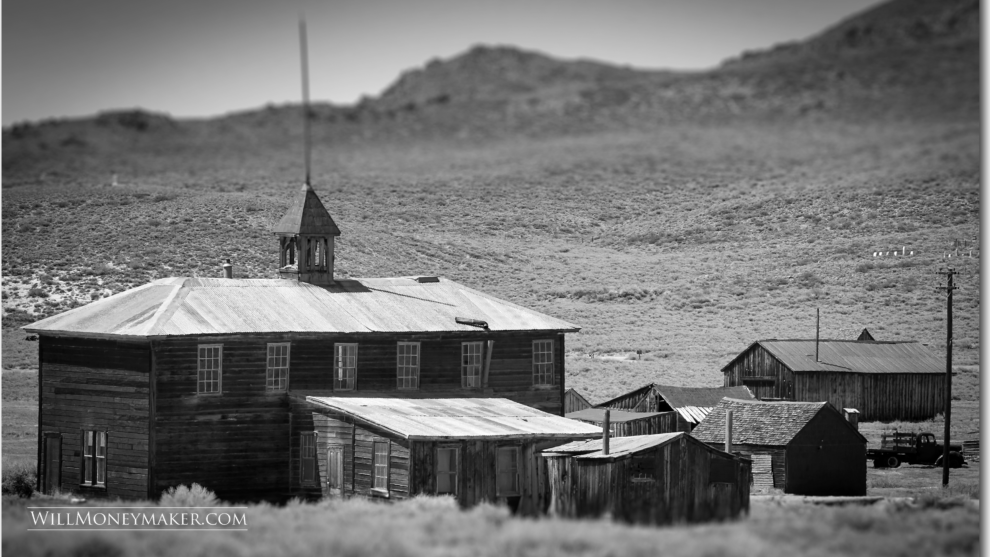
Photograph taken at Bodie State Historic Park near Bridgeport, California. Photograph by Will Moneymaker.
Photography Clips Newsletter
Keep looking. Keep creating.
Follow along with my photographs, journal entries, Photography Clips, and occasional life updates.
Free to join. Unsubscribe anytime.