Browse all Photography Clips episodes
I like reading about photographers because I want to know something about the person behind the photographs. The finished work shows me what they chose to include. Their lives give me a little more to think about. What interested them before photography? How did they earn a living? What did they keep doing when other people weren’t paying much attention?
Saul Leiter gives me plenty to consider. Looking at his work, I’m interested in how much he was willing to leave partly hidden. I don’t always get a complete view of a person or a street. Sometimes I get just enough to begin looking, and then I have to stay with the photograph for a while.
That makes me question how quickly I expect my own photographs to explain themselves.
Leiter was born in Pittsburgh in 1923 and moved to New York in 1946. Painting remained a lifelong interest. In the late 1940s, he began making color photographs, including pictures taken on walks close to home. He also worked professionally in fashion photography. Much later, his 2006 book Early Color brought wider attention to his personal work. He died in 2013. Those details help me understand a life spent working across more than one art form, with recognition arriving at different stages.
Photography Clips Newsletter
Get my latest articles, thoughts on photography and creativity, and Photography Clips episodes in your inbox.
What One Art Can Teach Another
The connection to painting interests me. I work with photography, sound, and music, and I’m drawn to the question of what one creative pursuit can teach another. I don’t think those interests have to stay in separate rooms. Something I understand through sound might help me think about a photograph. Something I notice in a photograph might give me an idea for music.
A pause, for example, has a place in music. It gives what came before it room to settle. I wonder whether an area of a photograph can do something similar. Does every part need to carry information? Could a quieter area help me spend more time with the rest?
I wouldn’t claim that Leiter was thinking about music when he made his photographs. That’s my own question, brought about by looking at his work.
His photographs often include wet windows, reflections, snow, and views partly interrupted by something in front of the camera. The Saul Leiter Foundation describes his interest in ambiguity and the influence of painters on his photographic work.
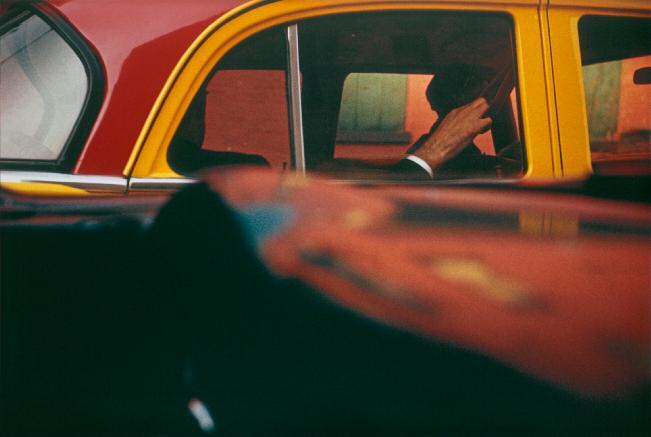
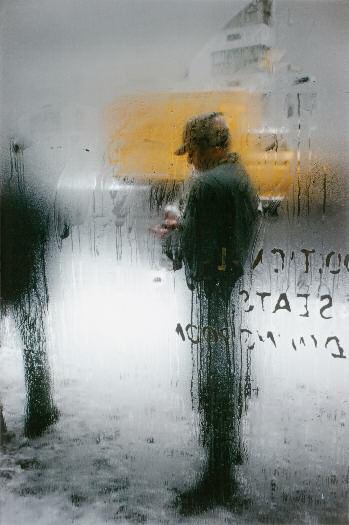
Two photographs from Saul Leiter: Retrospective, published by Kehrer Verlag, help me see that more clearly. In Taxi, the strong color and window frame give me only part of the passenger’s world. In Snow, the glass softens almost everything. Looking at these pictures together, I find myself paying more attention because so much remains unresolved.
Looking Through What’s in the Way
What I take from that is permission to reconsider what I might otherwise call an obstruction.
A window can keep me from seeing a subject clearly. It can also give me another surface to work with. A reflection can complicate a scene, but that complication might be the part that holds my attention. Before deciding that something is in the way, I could spend a little longer looking at what it contributes.
I still value a clear photograph. I’m interested in expanding the choices available to me. If I decide too early what a successful image should look like, I may dismiss something before I’ve understood why it caught my eye.
That’s one reason I enjoy learning about photographers whose work takes a different direction from mine. Their photographs give me questions I might not have asked on my own.
I don’t need to come away wanting to make photographs that look like theirs. I’d rather come away with a different question the next time I raise the camera.
With Leiter, that question might be: how much do I actually need to show?
If part of a scene catches my attention, perhaps I can begin there. I don’t have to include everything that would help someone reconstruct the location. The photograph can hold the part I wanted to look at, even if some of the surrounding information remains outside the frame.
Of course, leaving something out doesn’t automatically make an image interesting. A confusing photograph can simply be confusing. I still have to make choices, and I still have to decide whether those choices give someone a reason to keep looking.
But I don’t want to reject uncertainty just because I can’t explain it immediately.
Making Work Before It Finds an Audience
There’s also something encouraging about the long span of Leiter’s working life. His story makes me think about the distance between making photographs and receiving attention for them. Those two things don’t always happen together.
I want people to see my work. I enjoy knowing that a photograph has connected with someone. At the same time, I don’t want that response to become the only reason I keep making things.
Would I still be interested in a photograph before anyone else had seen it? Could I give an idea time to develop without immediately deciding where it belongs or how I’m going to share it?
Those are useful questions for me, especially when it’s easy to move straight from making something to preparing it for an audience.
What I’m learning from Leiter is a willingness to leave more room in that process. Room to look without having a finished idea. Room for one creative interest to influence another. Room to make a photograph that takes longer to understand.
I can admire his work and still make different choices. In fact, that may be the most useful result of studying another photographer: understanding my own choices a little better.
The next time something partly blocks my view, I’d like to pause before moving around it.
There may be a photograph from where I’m already standing.
Biographical source: Saul Leiter Foundation
Learn More
Saul Leiter: Early Color
The collection of color photographs discussed in this article, with a foreword by Martin Harrison.
Saul Leiter: The Centennial Retrospective
A broad collection of Leiter’s photography and other artwork, created in collaboration with the Saul Leiter Foundation.
More Thoughts
Images That Changed How I See
Thinking about how photographs can change the way I look at my own work.
One Photograph Can’t Tell the Whole Story
A reflection on how much one image can reveal.
The People Who Never Say Anything
Considering the people who connect with photographs without commenting.
About the Photograph
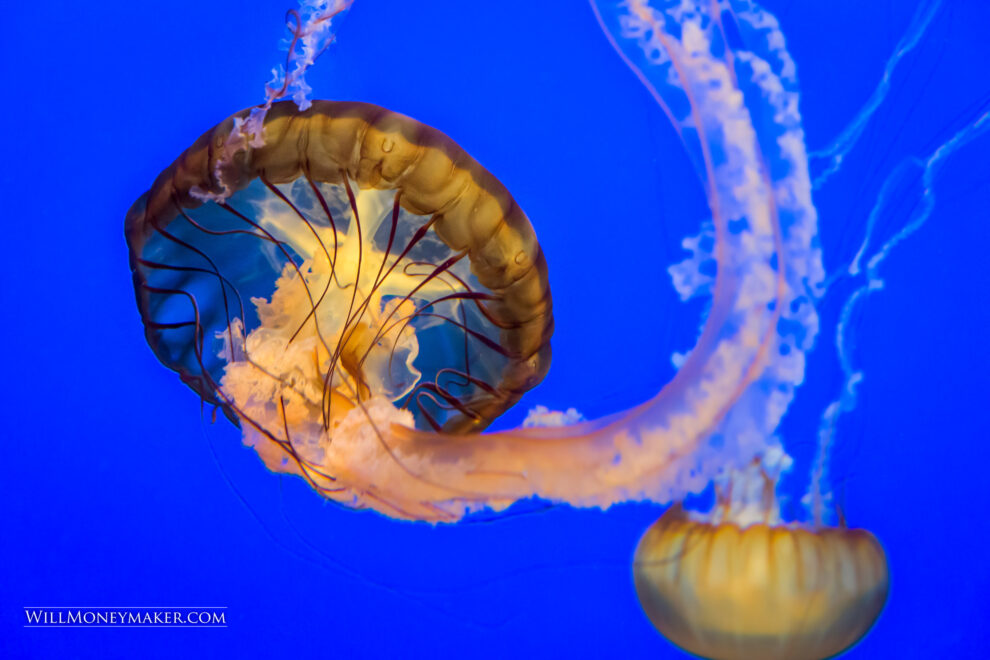
Photograph taken at Monterey Bay Aquarium in Monterey, California. The photograph shows black sea nettles. Photograph by Will Moneymaker.
Photography Clips Newsletter
Keep looking. Keep creating.
Follow along with my photographs, journal entries, Photography Clips, and occasional life updates.
Free to join. Unsubscribe anytime.