
I’ve had nights when I’ve sat in front of a screen full of photographs I should have been happy with and felt almost nothing. Sometimes, nothing stands out, even when every photograph is technically good.
Nothing was obviously wrong with them. The exposures were good. The compositions worked. The light was there. I could move from one image to the next and find something technically successful in almost every frame.
And sometimes I just shut down the computer and go to bed.
Maybe tomorrow will be better. Maybe I’ll look at them differently after some sleep, if I have time. But in that moment, I don’t want to keep forcing myself to find something in photographs that simply aren’t reaching me.
That can be harder to accept than coming home with a bad day of photography.
Photography Clips Newsletter
Get my latest articles, thoughts on photography and creativity, and Photography Clips episodes in your inbox.
A bad day is fairly easy to understand. The conditions didn’t come together. I missed something. I tried too hard. Maybe I never really found what I was looking for. Whatever the reason, I can usually recognize it and move on.
When nothing stands out
A folder full of good photographs is different.
Which one do I actually care about?
That question can be uncomfortable because “good” gives me plenty of places to hide. I can point to sharpness, color, timing, composition, or whatever else is working and convince myself that I’ve done my job. But after enough years of making photographs, technical success doesn’t always create a response.
Sometimes everything is good, and nothing reaches me.
That’s when I start wondering what I’m really looking for.
The photograph that keeps pulling me back
It doesn’t have to be the most dramatic frame. In fact, the photograph I keep returning to is sometimes quieter than the others. Maybe the composition isn’t as tidy. Maybe the light isn’t the strongest of the day. There may even be another frame beside it that is technically better.
And still, I choose the other one.
Why?
I don’t always know.
You may have had that happen too. You move through a group of photographs and one keeps pulling you back. There may be several around it that are easier to defend, but somehow this is the one you want to see again.
I’ve learned not to dismiss that too quickly.
There’s a difference between recognizing that a photograph works and actually responding to it.
I think that distinction has become more important as photography has become easier in some ways. Cameras are remarkably capable. Phones are capable. Editing software can correct things that would have been difficult to fix years ago. It’s possible to make technically clean photographs over and over again.
But technical quality can become so common that it stops being the thing that separates one photograph from another.
Looking beyond technical quality
The same thing happens outside photography.
There’s more music available than I could listen to in a lifetime. More movies than I could watch. More books than I could ever read. More photographs than I could possibly look at.
When there’s that much in front of us, it’s easy to move quickly.
Next.
Next.
Next.
I can do the same thing with my own files. I start evaluating instead of looking. I compare sharpness, framing, light, color, and little differences between one image and the next.
Eventually, I have to stop asking whether the photograph works and ask whether I care about it.
Those are not the same question.
A photograph can check every box and leave me cold. Another can have something slightly awkward about it and still refuse to let me go.
That’s where choosing becomes personal.
At some point, I have to put technique aside and admit what I respond to. That isn’t always easy to explain. I can tell you why I used a certain lens or why I framed something a particular way. It’s much harder to explain why one photograph gets through and another doesn’t.
Sometimes I simply know.
Other times I need distance.
Giving good photographs some distance
That’s why shutting down the computer can actually help. I’m not quitting on the photographs. I’m giving myself permission to stop judging them for a while. Tomorrow, or next week, I may see them differently. One image may begin to separate itself from the rest once I’m no longer staring at all of them together.
And sometimes nothing changes.
That’s fine too.
There have probably been photographs I passed over because I wasn’t ready for them yet. Months or years later, I may see one differently. The photograph didn’t change. I did.
When a photograph gets through
That idea reaches beyond photography for me.
There are things in life that can be perfectly fine and still disappear from memory. A meal can be beautifully prepared and forgotten. Another can be simple and become tied forever to a particular person or day. A conversation can seem ordinary when it happens and become important years later. A song can be nearly perfect and leave me untouched, while another finds something I can’t quite explain.
Photographs can work that way too.
The ones I remember aren’t always the ones that behaved themselves.
They’re the ones that got through.
So I don’t think a folder full of good photographs is a failure. Good work is still good work. But I also don’t need to pretend every successful frame means the same thing to me.
Some photographs can simply be good.
A few become more than that.
And when I can’t tell the difference, sometimes the best thing I can do is close the computer and go to bed.
More Thoughts
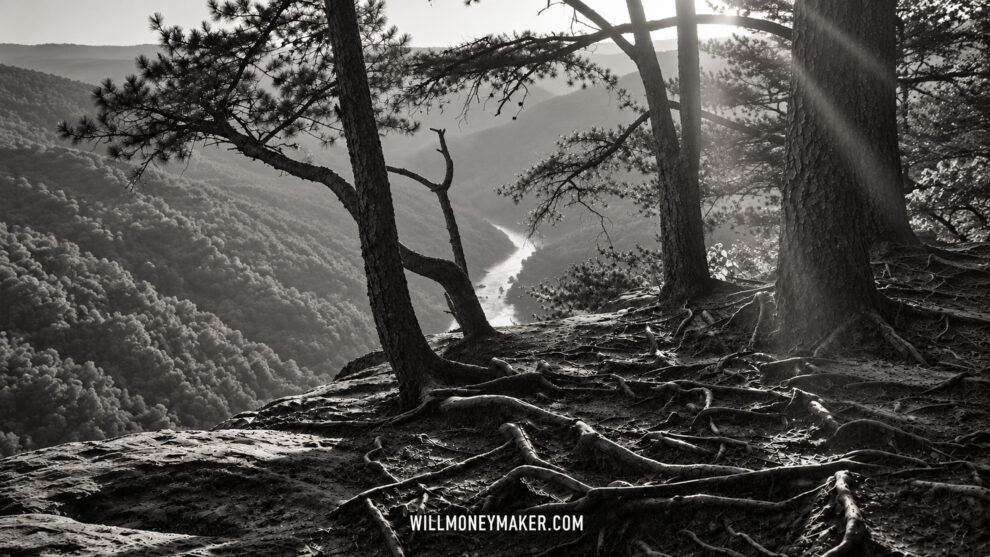
Photograph taken along Beauty Mountain Trail in the New River Gorge, West Virginia.
Photography Clips Newsletter
Keep looking. Keep creating.
Follow along with my photographs, journal entries, Photography Clips, and occasional life updates.
Free to join. Unsubscribe anytime.