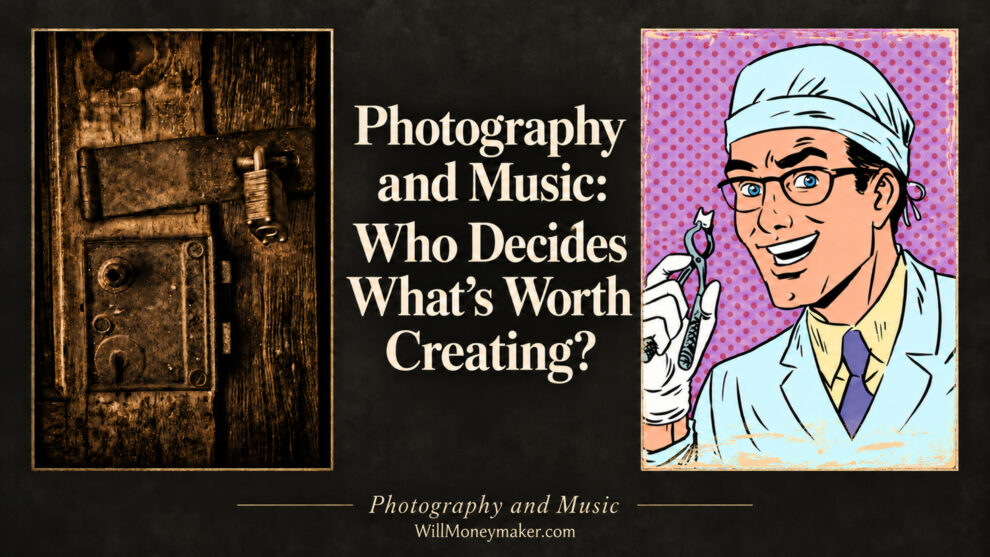
Not long ago, someone told me that the music I was creating was basically a waste of time. It made me think about photography and music, and what makes either one worth creating.
I’ve been working on a little project I call Music From the Doctor’s Office. It started simply enough. I spend more time than I would like sitting in doctors’ offices, waiting rooms, and medical appointments, and sometimes musical ideas come to me while I’m there. Instead of letting those ideas disappear, I started turning some of them into finished pieces.
I never expected them to become hit songs. I wasn’t trying to build a new career around them. I wasn’t sitting there thinking about how many people might listen or whether there was a market for what I was creating.
I was making music because I enjoyed making music.
So when someone suggested that it was a waste of time, the comment stayed with me for a while. Not because I thought they were necessarily trying to be cruel, but because it raised a question that goes far beyond music.
Photography Updates
Get my latest articles, thoughts on photography and creativity, and Photography Clips episodes in your inbox.
Who gets to decide whether something creative was worth the time it took to make?
Finding value in photography and music
There have been plenty of times when I’ve gone somewhere with my camera and returned with very little. I might have made one photograph I liked, or none at all. Sometimes I’ve spent an afternoon walking around and looking, only to discover later that almost everything on the memory card was ordinary.
Was the afternoon wasted?
I don’t think so.
Photography has never been only about what ends up on the memory card for me. There’s also the experience of being somewhere, paying attention, slowing my thoughts enough to notice what is around me, and looking at familiar things differently.
For me, the value of a photograph includes what I brought home, but it isn’t the whole thing.
I think photographers can get themselves into trouble when every trip with a camera has to produce something. We start judging the afternoon by the number of photographs we made. Then we judge the photographs by how many people respond to them. Before long, something that began as a personal creative experience starts feeling like it needs to prove itself.
That can take some of the enjoyment out of photography very quickly.
When Creative Work Doesn’t Come Together
You’ve probably experienced it yourself. You go somewhere expecting to make photographs, and nothing quite comes together. The light isn’t what you expected. The location isn’t as interesting as you remembered. Your own attention may simply be somewhere else that day.
You come home and think, “Well, that was a waste.”
But was it?
Maybe you noticed how late-afternoon light moved across a building. You might have found a street you had never walked before. Or you watched people for twenty minutes and began to notice small gestures you would normally have missed. Maybe you simply spent an hour away from everything else that had been occupying your mind.
None of those things necessarily produces a photograph you’ll hang on the wall.
They can still be part of being a photographer.
The same thing happens when I sit down with music. Sometimes I work on something that eventually becomes a finished piece. Other times I spend an hour experimenting with sounds, chords, or melodies that go nowhere.
But I learned something while doing it.
And sometimes learning isn’t even the point. Sometimes I simply enjoyed the hour.
Why does that need further justification?
We tend to grant certain activities permission to exist without requiring measurable results. Nobody asks whether watching a movie was productive enough. We don’t normally finish a good book and calculate whether the hours spent reading produced an acceptable return.
But creative work often gets judged differently.
When you write, someone eventually asks whether you’re going to publish it.
If you make music, someone asks whether you’re going to sell it.
If you make photographs, someone asks what you’re going to do with them.
Sometimes the answer is simply, “I wanted to make them.”
That can be enough.
I’m not saying goals are bad. I have goals with my photography. I publish photographs and write about photography. I want the work to be good. I want to keep improving, and when someone enjoys something I’ve made, I appreciate knowing that.
But the audience can’t be the only reason to create.
If it becomes the only reason, then someone else is always holding the measuring stick.
One photograph receives attention, so perhaps that one was worthwhile. Another gets almost no response, so maybe that one wasn’t. A piece of music gets played a few times, while another is hardly heard at all.
That seems like a strange way to decide the value of photography and music.
The Memories Around a Photograph
I remember the walking, the looking, the weather, the place, and, occasionally, the little surprises that made me raise the camera in the first place. Years later, the photograph can bring all of that back.
Someone else looking at the same photograph doesn’t have those memories attached to it.
They see the photograph.
I see what happened around it.
That difference is important.
And maybe that is something we forget when we spend too much time thinking about audiences. The value of a photograph includes more than the viewer sees. The photographer had another experience entirely.
Neither has to cancel out the other.
There are photographs I’ve made that I wouldn’t consider especially strong today. I’ve grown since then, and I can see things I would do differently now. But I wouldn’t call the time spent making them wasted.
Those photographs belong to the process that got me here.
For me, photography and music both belong to the same creative process.
Some of the little pieces from Music From the Doctor’s Office may be heard by a handful of people. Others may eventually disappear into a folder on a hard drive. I’m fine with that.
I made them.
I enjoyed making them.
They gave me something creative to think about during circumstances when I could have simply sat there waiting for the next appointment.
That doesn’t sound like wasted time to me.
And photography has given me far more of those hours than I could ever count.
Hours walking.
Time spent looking.
Hours experimenting.
Hours making photographs that worked and plenty that didn’t.
If I judged all those hours solely by the finished images, I would be overlooking a large part of why I’ve continued making photographs in the first place.
So when someone asks what a photograph is for, perhaps we don’t always need an elaborate answer.
Maybe it was made for a website.
Perhaps it was made for a book.
Maybe it was made for a client.
Or maybe you were standing somewhere, saw something that caught your attention, and wanted to photograph it.
That last reason is still a reason.
Creative work doesn’t always need to earn its keep.
Sometimes the value of photography and music began long before anyone saw or heard the work. It began the moment I decided to stop, pay attention, and make something.
More Thoughts
The People Who Never Say Anything
When Advice Becomes a Substitute for Seeing
What Could I Photograph in Twenty Minutes?