
Browse all Photography Clips episodes
I’ve been thinking about something that happens after I make a photograph. I lower the camera, stop thinking about the frame, and almost immediately, I notice something else.
Sometimes it’s small. A sound I’d stopped hearing. Someone shifting their weight. Light moving across a wall. A branch moving in the wind. Something happening just outside the area I’d decided was important enough to photograph.
It makes me wonder how much I notice while I’m actually using the camera.
Photography is supposed to make us more observant, and I think it does. Carrying a camera has taught me to pay attention to light, shapes, people, weather, buildings, expressions, and little changes that I might otherwise walk past. But the camera can also narrow my attention.
Photography Clips Newsletter
Get my latest articles, thoughts on photography and creativity, and Photography Clips episodes in your inbox.
Once I find something I want to photograph, I start making decisions. Where should I stand? What belongs in the frame? What should I leave out? Is the light better from the other side? Should I move closer? For a little while, the world becomes a rectangle.
That’s useful. It’s part of making a photograph. But I’ve begun to notice that the moment I lower the camera, the rectangle disappears, and the rest of the place comes back. I hear things again. I notice what people are doing when they’re not part of my composition. I look behind me. I notice how the place actually seems to me instead of how I’m trying to organize it into a photograph.
There’s something interesting about that. I’ve probably missed photographs because I was too busy making another one. I may have been concentrating so much on the scene in front of me that I never noticed what was happening ten feet away. That’s easy to do when I become convinced that I’ve found the photograph.
But I’m not sure the answer is simply to take more photographs. Maybe sometimes the better thing is to stop. I can stand there for another minute without looking through the viewfinder. I can listen. I can turn around. I can watch what changes after I’ve stopped trying to control the scene.
That doesn’t mean I suddenly become more aware of everything around me. I still miss things. Everyone does. But there’s a difference between looking for a photograph and simply looking.
When I’m looking for a photograph, I’m judging constantly. This works. That doesn’t. Move left. Wait for the person to leave. Wait for the person to enter. Change the lens. Change the exposure. Try again. When I put the camera down, some of that stops.
I can just be there.
And sometimes that’s when I understand what interested me about the place in the first place. It may not have been the building itself. It may have been how quiet the street was around it. It may not have been the person I photographed. It may have been the way everyone else reacted to that person. It may not have been the light. It may have been how the light changed the way the entire place looked for only a few minutes.
Those things are harder to fit into one photograph. That may be why I keep noticing them afterward.
I think photography has always had this strange relationship with attention. The camera makes me look more carefully, but it also asks me to choose. Every photograph says, in one way or another, look at this. The problem is that while I’m saying look at this, there’s still an entire world outside the frame.
I don’t think that’s a weakness of photography. It’s simply something worth remembering. A photograph can’t contain everything I experienced while standing there. It can’t include every sound, every movement, every thought, or everything happening beside me.
I have to choose what goes into the frame. But I do not have to stop paying attention to everything else.
Maybe one of the habits I want to practice more often is staying for a moment after I think I’ve finished. Lower the camera. Stop looking at the back screen. Don’t immediately walk away. Just look again.
I may make another photograph. I may not. Either way, I might notice something I would’ve missed if I’d left the moment I thought the photography was over.
And lately, I’ve been wondering whether that moment, after the camera comes down, might sometimes be the moment when I start seeing the place most clearly.
More Thoughts
The Things I Keep Walking Past
A reflection on familiar subjects I might overlook.
What Could I Photograph in Twenty Minutes?
Finding photographs close to home with the time I have.
One Photograph Can’t Tell the Whole Story
Thinking about what a single photograph can show.
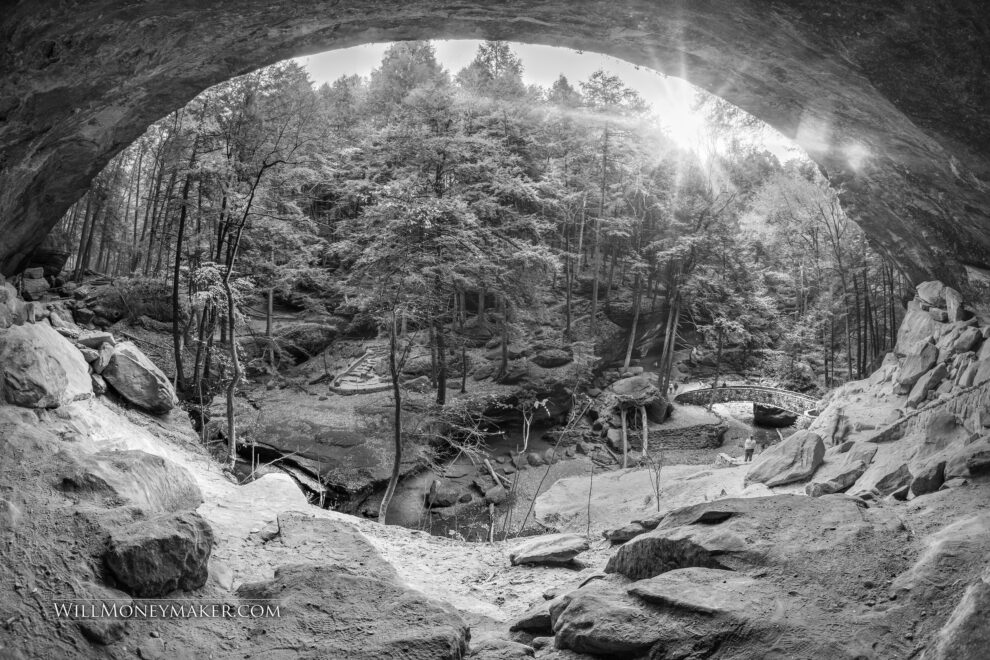
Photograph taken at Hocking Hills State Park, Ohio. Photograph by Will Moneymaker.
Photography Clips Newsletter
Keep looking. Keep creating.
Follow along with my photographs, journal entries, Photography Clips, and occasional life updates.
Free to join. Unsubscribe anytime.