
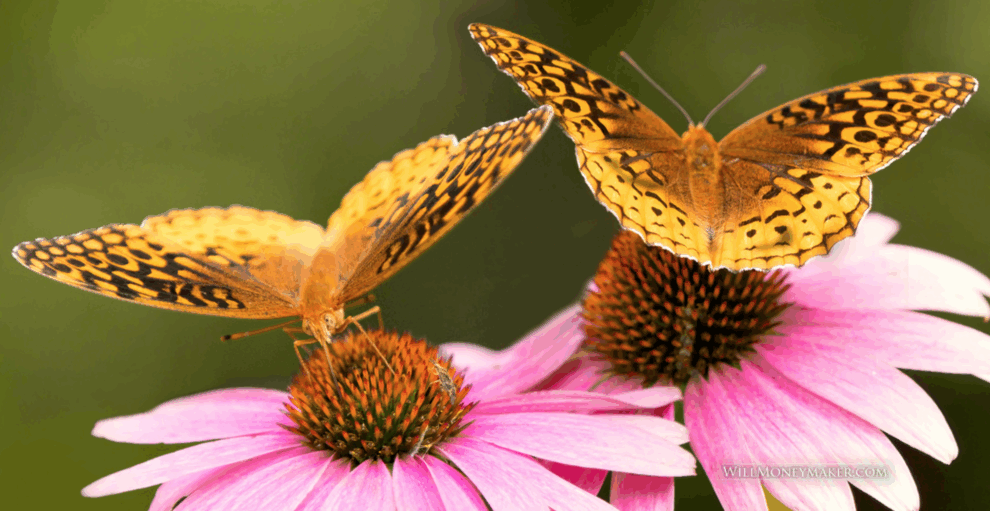
I spotted these two beautiful Great Spangled Fritillary butterflies in our backyard. A small encounter like this is one of the pleasures of photographing butterflies: there can be something worth looking at close to home, without planning a special trip.
The Great Spangled Fritillary
The Great Spangled Fritillary (Speyeria cybele) belongs to the brush-footed butterfly family, Nymphalidae. Its orange-and-black upper wings and the pale markings beneath the wings reward a closer look. Identification can be easier when you have photographs of both sides, since similar fritillaries can be difficult to tell apart.
Adults are seen during the warmer months, but their flight period varies with location and conditions. Regional butterfly guides can help you understand when to look in your area. The caterpillars use violets as host plants, so the plants that support a butterfly’s life cycle may be different from the flowers visited by adults.
Photographing Butterflies with Patience
Give the subject room and watch before moving closer. Notice which flowers it returns to and how it settles. A slower approach can give you time to compose without repeatedly disturbing it. Avoid handling butterflies or changing their surroundings just to get a photograph.
Pay attention to the eye and the angle of the wings. At close distances, depth of field can be shallow. If you want more wing detail sharp, try changing your position so the wing lies closer to the same plane as your camera’s sensor. Check a test frame rather than assuming a small aperture will solve everything.
A simple background can make the shape and pattern easier to see. Before pressing the shutter, look around the edges of the frame for bright distractions. Then check your shutter speed against both the butterfly’s movement and your own. Light, distance, and movement will determine what works; there is no single setting for every encounter.
Photographing butterflies is also a reason to pause and notice the life around us. Even when a subject flies away before the photograph comes together, the time spent watching is worthwhile.
Learn More
Illinois DNR: Great Spangled Fritillary and Its Life Cycle
Butterflies and Moths of North America: Great Spangled Fritillary Identification
* Photograph taken in my backyard.
Photography Clips Newsletter
Keep looking. Keep creating.
Follow along with my photographs, journal entries, Photography Clips, and occasional life updates.
Free to join. Unsubscribe anytime.