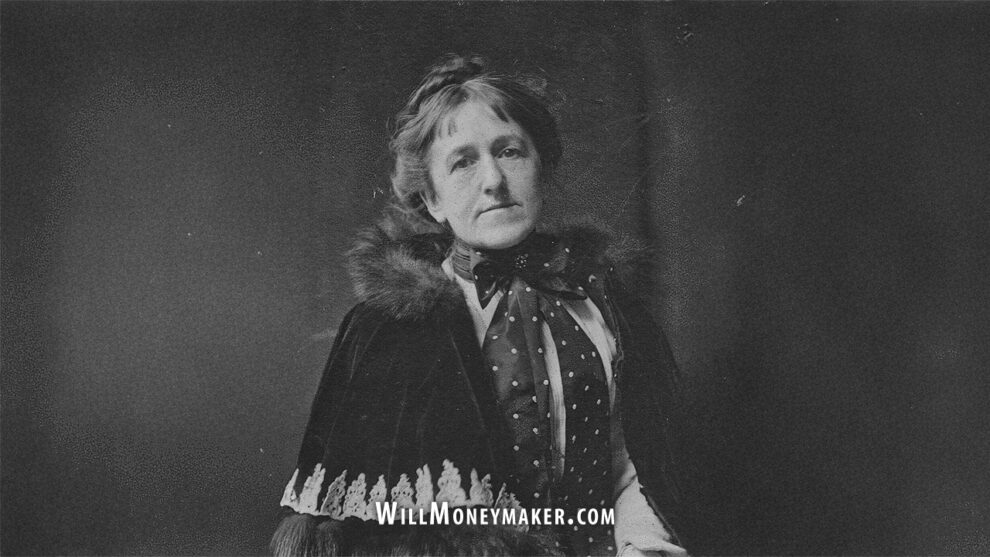
In the world of early American photography, few names carry the elegance and influence of Gertrude Käsebier (1852–1934). She is often hailed as one of the first American photographers to elevate portraiture to an art form. Her best-known works, particularly images of mothers and children, embody a tenderness and depth that was revolutionary for her time. Through her lens, she captured the emotional bond between her subjects with unique sensitivity, helping to pave the way for what would later be known as the pictorialist movement—a style focused on creating painterly, atmospheric photos. Her work is a reminder of the quiet power of the photograph to convey feelings that words might struggle to capture.
A Late Start with a Lasting Impact
Her journey into photography wasn’t immediate; in fact, she didn’t begin her career until she was in her forties. Born on May 18, 1852, in Fort Des Moines, Iowa, Gertrude Stanton was the daughter of a miller and spent much of her early life moving across the country as her father sought work. After he passed away, her mother moved the family to Brooklyn, where she eventually married Eduard Käsebier and started a family of her own. The marriage, however, was challenging, and she found herself turning to art as a way to express herself and find purpose outside of her domestic life.
Despite the unconventional start, her love for art blossomed as she studied painting in New York and later in Paris. But when she discovered photography, everything changed. She embraced the medium, fascinated by its potential to capture life’s fleeting moments with both intimacy and artistry. By her mid-forties, she was working as a professional photographer—a choice that was rare for women of her time. Yet, she thrived, and her work soon became known for its gentle, evocative style that brought out the essence of her subjects.
Pioneering the Pictorialist Movement
She became a major figure in the pictorialist movement, a style that aimed to elevate photography beyond simple documentation. She developed an evocative, soft-focus approach that lent her portraits a dreamlike, almost ethereal quality, as if her subjects were bathed in a soft, warm glow. These portraits weren’t just pictures; they were mood pieces that invited viewers to feel the quiet beauty of her subjects.
One of her most famous works, Blessed Art Thou Among Women (1899), perfectly exemplifies her style and artistic philosophy. In this image, she captures author Agnes Rand Lee and her young daughter, Peggy. The composition, with Agnes standing protectively over Peggy, exudes a sense of maternal warmth and devotion. The soft-focus technique draws viewers into an intimate, almost sacred space where we’re invited to witness a private moment between mother and child. This photograph has a timeless quality, one that resonates as much today as it did over a century ago. Her sensitivity to her subjects, especially mothers and children, set her apart from her peers and established her as a leading voice in the emerging field of portrait photography.
Celebrating Motherhood and the Feminine Spirit
She had a gift for capturing the bond between mothers and their children—a theme that would become central to her work. At a time when women’s roles were largely confined to the domestic sphere, her portraits revealed the profound beauty of motherhood in a way that few others had done. Her portraits weren’t merely representations of the mother-child relationship; they were tributes to the strength and tenderness of women. Through her lens, she celebrated the feminine spirit, presenting it as a source of resilience, beauty, and grace.
What’s especially powerful about her work is how she highlighted women’s inner lives. In her portraits, mothers aren’t just passive figures; they are strong, self-assured, and full of presence. Her images radiate with respect for her subjects, inviting viewers to see beyond the surface and connect with the emotions she carefully captured. For anyone who loves portrait photography, her work is a masterclass in empathy and expression.
An Advocate for the Artistic Potential of Photography
Beyond her role as a photographer, she was a vocal advocate for the recognition of photography as a legitimate art form. In a time when the medium was often dismissed as merely a technical skill, she argued that photography could be as expressive and impactful as painting or sculpture. She was a founding member of the Photo-Secession group led by Alfred Stieglitz, which sought to promote photography as fine art. This group, along with Stieglitz’s gallery and publication Camera Work, helped introduce her work to a wider audience and cemented her reputation as a groundbreaking artist.
Despite her success and influence, her relationship with the Photo-Secession group was complex. She often clashed with Stieglitz over artistic control and personal values, eventually distancing herself from the group. But her commitment to photography never wavered. She continued to work independently, remaining true to her vision and continuing to push the boundaries of portraiture.
Lessons from Käsebier for Today’s Photographers
For anyone with a passion for portrait photography, her work offers a wealth of inspiration. She taught us that photography can do more than capture a person’s appearance—it can capture their essence, their spirit, and their relationships. Her portraits remind us that every photograph has the potential to tell a story, to reveal something genuine and heartfelt. Her work is a reminder that technical skill is only part of the equation; what matters most is the connection between photographer and subject.
Her legacy is a call to approach photography with intention and empathy, to see our subjects as individuals with lives, emotions, and stories worth honoring. Her soft-focus technique, which she pioneered to create an almost painterly effect, continues to inspire photographers who seek to infuse their images with depth and emotion. Her life and work encourage us to consider how we can use our craft to express our own perspectives and to elevate the ordinary moments we capture into something timeless and profound.
A Lasting Influence
In a field that was often dominated by men, she carved out a space for herself through sheer talent and determination. She showed the world that photography could be personal, expressive, and deeply human. Her work continues to resonate not only because of its technical brilliance but because of its emotional honesty. Her portraits of mothers and children invite us into an intimate, gentle world that feels as relevant and moving today as it did over a century ago.
For those of us who love photography, her story is an inspiring example of the power of vision and compassion. She reminds us that a photograph can be more than an image—it can be a feeling, a connection, a tribute to life itself. Gertrude Käsebier passed away in 1934, but her legacy endures. So, the next time you’re capturing a portrait, think of her quiet strength, the warmth she brought to her work, and let that guide you in creating your own meaningful, timeless images.